Cycling the Werribee River Bike Trail
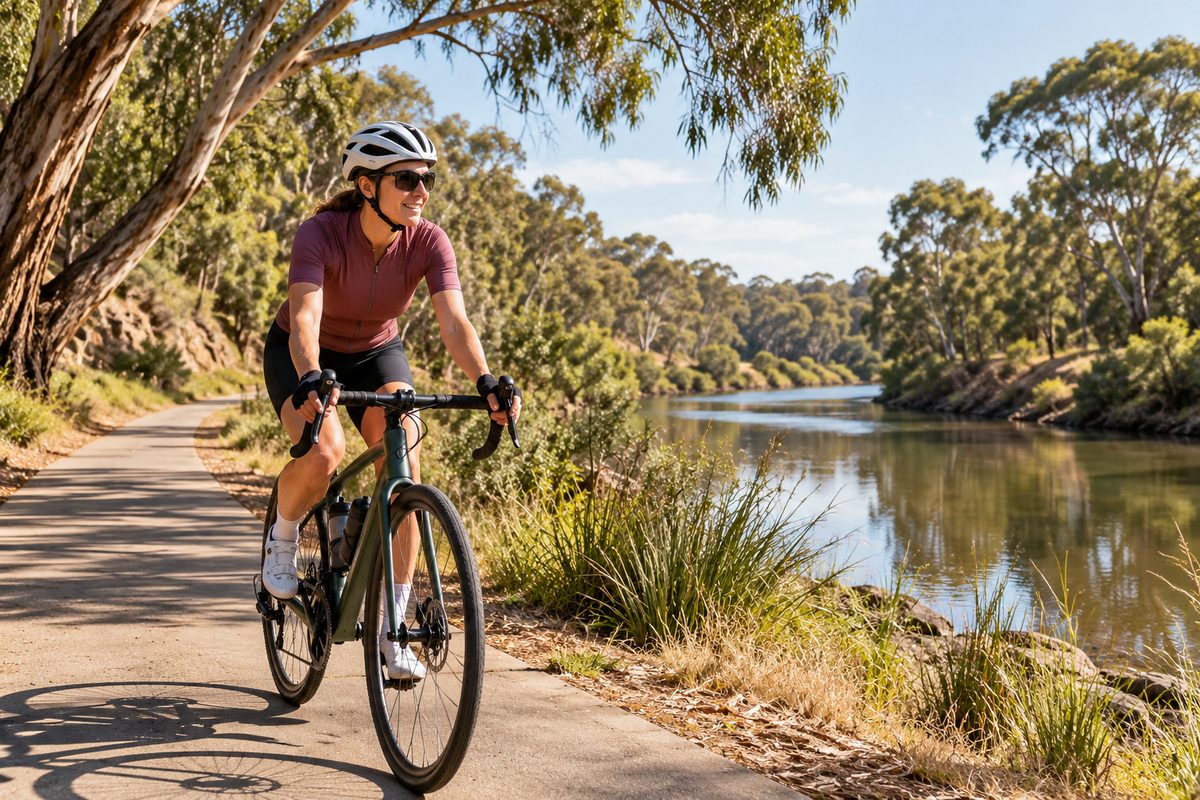
The Werribee River Trail is a mostly flat, sealed riverside path that runs roughly 15 to 20 kilometres one way, from the coast at Werribee South, through central Werribee, and north to Wyndham Vale, and almost any rider on almost any bike can do it. The full trip is easy on your legs. Where people slip up is timing, direction and planning for the far end. This guide covers those parts, along with the science of why a slow river ride does more for your body and brain than most people think.
In my experience, most riders treat this trail like a gym session on wheels. They ride hard, look at the path and miss the reason to come here. I think that gets it backwards. The flat path and moving water make this trail a tool for calming your nervous system first and building fitness second. Ride it that way and you get both.
Where does the trail actually go?
The trail follows the Werribee River through the City of Wyndham. Think of it in three parts.
- The coast section. This starts near the river mouth at Werribee South, where the river empties into Port Phillip. It is open, flat and windy, with farmland and market gardens on one side.
- The park section. Heading north, the path passes the K Road Cliffs and runs close to Werribee Park and the Werribee Open Range Zoo. This is the quietest and greenest stretch.
- The town and north section. The path reaches central Werribee at Chirnside Park, a short ride from Werribee railway station, then keeps going upstream toward Wyndham Vale.
Near Werribee, the trail also links with the Federation Trail, a long off road path that heads east toward the inner west of Melbourne. That link turns a local loop into a real commuting route if you want one.
Most of the path is Asphalt concrete or a similar sealed surface. A few short sections near the coast and some side tracks are compacted gravel. The council classes the main route as a Shared-use path, so walkers, dogs, kids and prams share it with you.
What bike and gear do you really need?
Any working bike with air in the tyres will do the job. You do not need a road bike or a mountain bike. A hybrid or a basic commuter is ideal because the gravel patches near the coast feel rough on very thin tyres.
When I tried this route on narrow road tyres, the sealed parts felt fast and the gravel felt shaky. Tyres around 32 to 40 millimetres wide fixed that. Here is the short list that matters.
- A bell. You will pass walkers often. Ring early and slow down.
- Two litres of water in summer. There is little shade near the coast and few taps between town and the river mouth.
- A spare tube and pump. Thorns and glass show up near car parks.
- Sunglasses. The wind on the coast section throws grit and insects into your eyes.
- A front and rear light. Even in daytime, the tree cover in the river valley gets dark.
Ebikes work well here. The path is flat enough that you will barely use the motor, except on the short climbs out of the valley near the cliffs and in town.
Which direction should you ride first?
Ride toward the coast first in the morning, then come home with the wind behind you. This is my strongest piece of advice, and few guides mention it.
What I saw on many rides was that the wind on the open coast section near Werribee South is the hardest part of the whole trip. Melbourne often gets a sea breeze off Port Phillip that builds through the late morning and afternoon. If you ride south early, the air is calmer. By the time you turn around, the breeze has picked up and it pushes you back inland.
Most people do the opposite. They cruise out on an easy tailwind, turn around tired and grind home into a headwind on a path with no shade. That one mistake turns a pleasant ride into a hard one.
A second option skips the problem. Ride one way only and use the train for the return. More on that below.
How hard is this ride on your body?
For most adults, the ride sits in easy aerobic territory, often called zone 2, where you can still talk in full sentences. That is exactly where you want to be most of the time.
Zone 2 work trains your mitochondria, the parts of your cells that turn fuel into energy. Research on endurance training shows this kind of steady, easy effort improves how well your muscles burn fat and how your heart handles longer efforts. Many health researchers suggest around 150 to 200 minutes a week of this type of work. A round trip on this trail at a relaxed pace takes about 90 minutes to two hours, so one ride covers a big share of your week.
The long term data backs this up. A large UK study published in the BMJ in 2017 followed more than 260,000 adults. People who cycled to work had about a 41 percent lower risk of dying from any cause, and lower rates of heart disease and cancer, compared with people who drove or took public transport. That study looked at commuting, not weekend rides, but the takeaway holds. Regular, moderate riding is one of the best returns on time you can get.
Here is a simple way to check your effort without a heart rate monitor.
- Breathe only through your nose for the first 15 minutes.
- If you have to open your mouth, slow down.
- If you can sing a full line of a song, you can push a little harder.
I found that this nose breathing rule keeps riders from blowing up on the first stretch, which happens often on flat paths because flat feels like it should be easy.
Why does riding next to a river change how you feel?
Moving through nature with a wide field of view lowers stress and quiets repetitive negative thinking, and the river valley gives you a lot of both.
A 2015 Stanford study by Gregory Bratman had people walk for 90 minutes in either a natural setting or beside a busy road. The nature group reported less rumination, which means less looping on the same worried thoughts. Brain scans also showed lower activity in the subgenual prefrontal cortex, an area linked to that kind of thinking. The road group showed no change.
There is also the visual side. When you move forward and the world flows past you, your eyes take in what scientists call optic flow. In my view, this forward motion with a relaxed, wide gaze is one of the simplest ways to shift your body out of a stressed state. You see it in how people talk after a ride. They feel calmer, and their thoughts feel less stuck.
The river corridor adds something else. The trail runs through the riparian zone, the strip of land along the water where river red gums, reeds and native shrubs grow. This band of plants cools the air on hot days, blocks some road noise and brings in birds. On the park section near Werribee Park, you often hear more birds than cars.
Here is my left of centre take. Leave the headphones at home. When you add a podcast, your attention narrows and you lose much of the calming effect of the wide view and natural sound. Ride the first half in silence. Notice the difference.
What should you stop for on the way?
Plan three stops, the river mouth, the K Road Cliffs and Chirnside Park, and you will see the best of the trail without rushing.
The river mouth at Werribee South
This is where the river meets the bay. It is flat and wide with big sky views over Port Phillip. On a clear morning you can see across the water. Bring a snack and sit for ten minutes. Early light here is bright, which helps set your body clock if you ride soon after sunrise.
K Road Cliffs
The cliffs drop down to the river and give you one of the few raised views on the trail. Stay back from the edge, since the ground can crumble. The short climb up gives your legs a small, useful jolt in an otherwise flat ride.
Werribee Park and the zoo
The path runs near Werribee Park, with its mansion and gardens, and the Werribee Open Range Zoo. You cannot ride into the zoo from the trail, but you can lock up and visit if you plan a longer day. Some riders hear lions from the path in the morning, which surprises people.
Chirnside Park in town
This park sits right by the river in central Werribee. It has toilets, grass, shade and cafes a short walk away. It makes a natural start or finish point, especially if you come by train.
When is the best time to ride, and when should you stay home?
Ride in the first two hours after sunrise from spring to autumn, and skip the coast section on days above 32 degrees or with strong winds.
Morning rides do two jobs. The air is cooler and calmer, and you get bright outdoor light into your eyes early in the day. Morning light exposure helps set your circadian rhythm, which supports better sleep that night and steadier energy through the day. Studies on light and sleep timing back this up, and in my experience the effect is easy to feel within a week of regular morning rides.
Skip or shorten the ride when you see these conditions.
- Hot north winds. The coast section has almost no shade and heat stress builds fast.
- After heavy rain. Low parts of the path near the river can flood or turn muddy, and councils sometimes close sections.
- Warm afternoons in spring and summer. Snakes, including tiger snakes and eastern browns, sun themselves near the path edge. Stay on the sealed surface and give them space.
Winter mornings are cold and often foggy along the river but very quiet. Wear gloves and lights, and you will have long stretches to yourself.
How do you get there by train?
Take the train to Werribee railway station, ride about five to ten minutes to Chirnside Park and join the trail there.
Metro trains allow bikes on board, and outside peak hours there is plenty of room. Werribee is the end of the line, so you do not have to worry about missing your stop. From the station, head toward the river and you will hit the path at Chirnside Park.
The train also unlocks the smartest version of this ride. Ride one way and train back. For example, start at the train station, ride south to the coast and back to town, then hop on the Federation Trail and ride east toward Hoppers Crossing or further, catching a train home from whichever station you reach when your legs say stop. You get a long ride without the dread of a long return.
If you drive, there is parking near Chirnside Park, near Werribee Park and at a few spots near Werribee South. Weekend car parks near the zoo fill early.
A simple plan for your first ride
Start in town, ride to the coast and back, and keep the whole trip under two and a half hours including stops. This plan works for beginners, kids over about ten and anyone coming back to riding.
- Check the weather the night before. Look at wind direction and the top temperature. If it tops 32 degrees, change the plan.
- Arrive at Chirnside Park within an hour or two of sunrise. Use the toilets and fill your bottles.
- Ride south toward Werribee South. Breathe through your nose for the first 15 minutes and keep the pace easy.
- Stop at the K Road Cliffs. Take in the view, then keep going.
- Reach the river mouth. Sit for ten minutes, eat something, look out over Port Phillip.
- Turn around and ride home with the breeze at your back. Pick up the pace a little if you feel good.
- Finish at Chirnside Park. Walk to a cafe or back to the station.
Once that feels easy, add the north section toward Wyndham Vale, or link the Federation Trail for a longer day. The base ride rarely changes. Early start, easy effort, wind at your back on the way home.
People who get the most from cycling the werribee river bike trail treat it as something they do every week, not a once a year outing. In my experience, the weekly habit matters far more than the distance. A one hour easy ride every Saturday morning, in sunlight, beside moving water, does more for sleep, mood and heart health than a single big effort you dread and then avoid. Keep it easy, keep it regular, and let the river do the rest.