Playgrounds Near Werribee City Centre
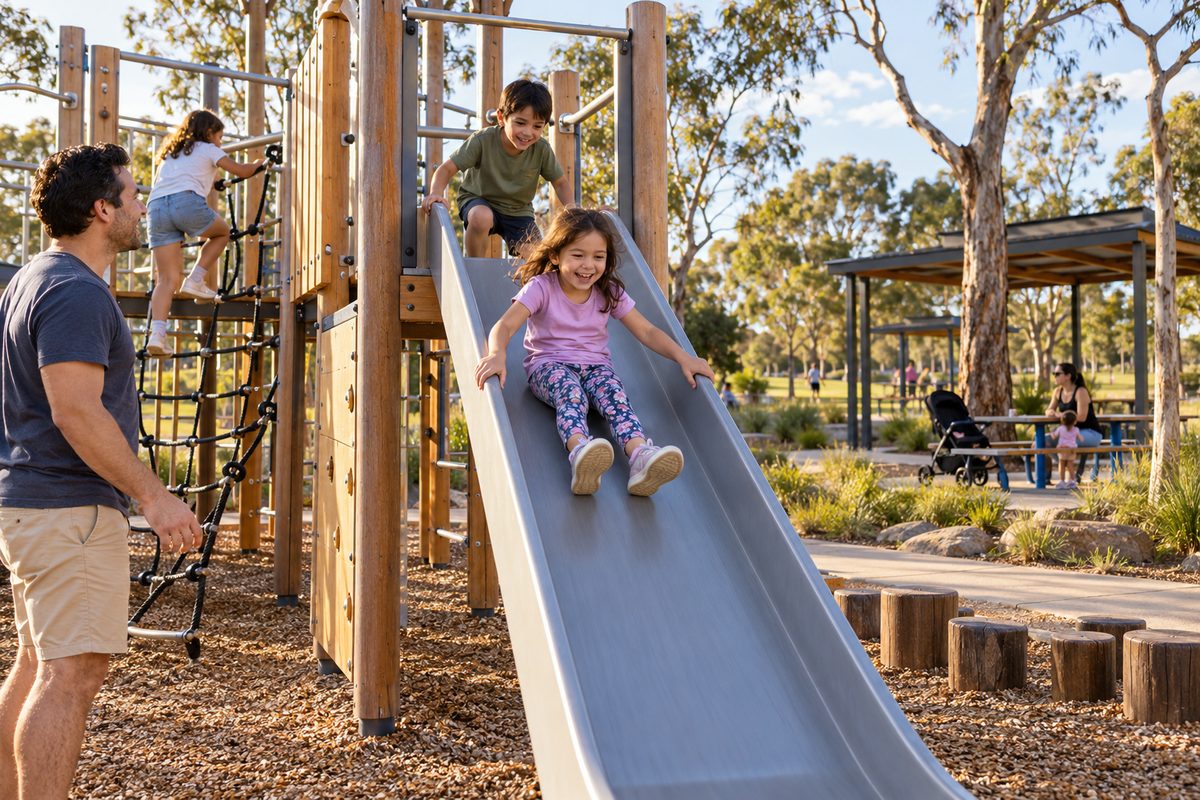
The best playground near the centre is Chirnside Park on Watton Street, and the best way to get there is on foot from Werribee railway station. It sits beside the Werribee River, so you get play equipment, open grass, shade trees and a river path in one stop. It's not the newest playground in the City of Wyndham, and that matters less than most parents think. The walk there, the time of day you go and the surface under the swings do more for your kids than the size of the climbing frame.
This guide covers how to choose a playground by age, why I rate the walk above the equipment, what the rubber under the swings is made of, and how to build a full day out from one play stop.
Where should you start if you arrive by train?
Start at the train station and walk down Watton Street toward the river. It's a short, flat walk past cafes and shops, and you finish at Chirnside Park.
Watton Street shares its name with Watton, Norfolk, a small market town in England. What I noticed in both places is the same layout. The shops run in a line, and the green space sits at the low end near the water. Towns built like this make it easy to pair a coffee run with a play stop, and you never need the car.
When I tried this route with young kids, here's what worked.
- Get off at Werribee railway station and use the toilets at the station or a cafe before you set off.
- Walk Watton Street toward the river. Let the kids lead and count crossings.
- Play at Chirnside Park for 45 to 60 minutes.
- Walk a loop of the Werribee River Trail before you head back.
- Eat on the way back up Watton Street, once the kids are tired and hungry.
Doing the food last is the trick. Hungry kids eat. Kids who have eaten before the park don't want to leave the cafe.
Why does the walk matter more than the slide?
The walk counts as exercise and the slide mostly doesn't. Most kids get less movement at a playground than parents assume, because they spend a lot of time standing, waiting and talking.
Australia's movement guidelines say children aged 5 to 17 need at least 60 minutes of moderate to vigorous activity every day. Children under five need about 180 minutes of physical activity spread across the day. Most Australian kids don't hit these targets, and that pattern has held for years in national surveys.
In my experience, a 15 minute walk each way to the park does more for that daily number than an extra half hour on the equipment. The walk raises heart rate steadily. Play comes in short bursts. You want both, so stop choosing the playground with the biggest structure and choose the one with the best route to it.
This is the first idea I'd push back on. Parents rank playgrounds by what's in them. Rank them by how you get there.
Which playground suits which age?
Match the playground to the age of your youngest child, and then add a challenge for the older ones. Here's how I sort them.
Toddlers, around 1 to 3 years
- Low platforms, under about a metre
- A fenced area or a clear line of sight from one bench
- Toddler swings with bucket seats
- Sand or soft rubber under the play gear
- A public toilet within a short walk
Preschoolers, around 3 to 5 years
- Climbing nets and short ladders
- Balance beams and stepping logs
- Open grass for running
- Some shade over the play area
School age, around 6 to 12 years
- Taller climbing frames and spinners
- Space for bikes and scooters
- Paths linked to cycling infrastructure, so they can ride there with you
- Ball space or courts nearby
What I saw with older kids was simple. Once a child can climb everything in a playground in five minutes, they stop playing and start asking for screens. For that age, the Werribee River Trail beats any single playground. Bring the bikes, ride the shared path, and use the playground as a rest stop rather than the main event.
Is boring play equipment bad for kids?
No. Plain playgrounds with some real risk often beat shiny new ones. This is the second idea I'd push hard on.
A 2015 systematic review led by Mariana Brussoni at the University of British Columbia looked at studies on risky outdoor play. Kids who had more chances to climb, balance and explore on their own were more active, and they showed better social skills and creativity. The review found no evidence that this kind of play raised serious injury rates beyond normal play.
What that means for you is this. A playground with a tree to climb, a slope to roll down and a bit of river bank to look at gives a child more to work out than a big plastic set with one way up and one way down.
When I tried stepping back on a bench and not calling out "be careful" every 30 seconds, the play got longer and calmer. Kids test their limits in small steps when no one interrupts them. Stay close enough to help and quiet enough to let them think.
Is the rubber under the swings safe?
Yes, for most kids it is. The soft rubber surface under Australian play equipment has to meet a national standard for absorbing falls, and it works well when it's kept in good condition.
Playgrounds in Victoria (state) and across Australia follow AS 4685 for equipment and AS/NZS 4422 for the surface underneath. The surface standard tests how well a material softens a fall from a set height. Falls cause most playground injuries that end in a hospital visit, so this surface matters more than anything else in the park.
Here's what people get wrong. Most poured rubber surfaces use synthetic rubber, often recycled tyre crumb with a coloured top layer. They are not made from natural rubber latex. That means latex allergy from the ground is unlikely. If your child has a latex allergy, check the hand grips and toys instead, and talk to your doctor about what to avoid.
Look for these warning signs on any surface.
- Cracks, holes or edges peeling up, which trip kids
- Hard, packed patches under swings and slide ends
- Bark or sand pushed away so you can see the ground
- Dark rubber in full sun on a hot day
That last one catches families every summer. Dark rubber surfaces and metal slides can get hot enough to burn skin on a hot afternoon. Touch the surface with the back of your hand before your child sits or crawls on it. If you can't hold your hand there for a few seconds, it's too hot for them.
When is the best time of day to go?
Go in the morning. This is the third idea, and it's the one I care about most.
Morning outdoor light helps set the body clock. Kids who get bright light early tend to fall asleep more easily that night. Outdoor light also protects their eyes. A large trial in China published in JAMA in 2015 added 40 minutes of outdoor time to the school day. Over three years, about 30 percent of those kids developed short sightedness, compared with about 40 percent of kids who didn't get the extra time. An earlier study in Taiwan found a similar result with outdoor time at recess.
What this means is that outdoor time isn't just for fun. Daylight is far brighter than indoor light, even on a cloudy day, and the eye seems to need that brightness while it grows.
In my experience, the best window is the first two hours after breakfast. The park is quieter, the surfaces are cool and the UV is lower. In Victoria, SunSmart says to use sun protection when the UV index reaches 3 or higher, which is most days from mid August to the end of April. Hats, sunscreen and shade still matter in the morning in summer.
Where do you go on a wet or very hot day?
Go indoors and keep it short. Pacific Werribee, the large shopping centre a short drive or bus ride from the centre, works as a backup when it's pouring or the heat is extreme. Check the centre directory for current kids areas before you go, because shops and play spaces change.
I found that indoor play works best as a short stop, not a full morning. Kids get less daylight and less movement inside. If the rain clears, head back out. A wet playground with puddles beats a dry food court for almost every child I've watched.
On hot days, change the plan instead of skipping it.
- Go before 10am and leave before the surfaces heat up
- Choose parks with big trees over parks with shade sails only
- Walk the river path, which tends to feel cooler than open streets
- Bring more water than you think you need
How do you turn one play stop into a full day out?
Pair the playground with one bigger trip, not three. Kids do well with one main event and a lot of free time around it.
Here are the combinations that work best from the city centre.
- Playground and river ride. Chirnside Park, then a ride or scooter along the Werribee River Trail. Best for school age kids with bikes.
- Werribee Park and the Rose garden. Werribee Park sits south of the town and holds the Victoria State Rose Garden, the mansion and wide lawns. Toddlers love the open grass and paths. Go in spring for the roses.
- Werribee Open Range Zoo. The zoo sits next to Werribee Park. Make it its own day. Pairing it with a playground stop on the same day usually leaves kids too tired to enjoy either.
- A weekend game. Werribee City FC plays at Galvin Park in Werribee. Watching a local game gets kids outside and moving, and there's often space to kick a ball around nearby.
When I tried stacking the zoo, the rose garden and a playground into one day, it went badly. The kids melted down by mid afternoon. One big outing plus a playground on the walk home works better every time.
What should you bring?
Bring less gear and more water. Here's the short list I use.
- Water bottles for everyone, filled before you leave
- Hats with a brim and sunscreen
- A spare set of clothes for kids under five
- A simple snack for after play, not before
- Bikes or scooters and helmets if you plan to use the river trail
- Hand wipes, since you can't count on soap at every public toilet
Before you set out, check the City of Wyndham website for park facilities. It lists which reserves have toilets, barbecues and shade, and it posts closures when equipment is being repaired.
What's the simplest plan for this week?
Pick one morning. Walk or ride from the train station to Chirnside Park. Play for an hour, walk a stretch of the Werribee River, and eat on the way home.
That one routine gives your kids morning light, a solid chunk of their daily movement and real outdoor play. Repeat it twice a week and you'll see the change in how they sleep and how calm they are in the afternoon. That's what I'd focus on with playgrounds near werribee city centre. The route, the timing and the surface do the work. The equipment is the bonus.